Logo Design Ideas

 Saba Mirza
Technology, Business &
Digital Marketing Writer
Saba Mirza is a Technology, Business
& Digital Marketing Writer at Lead
Loom Web with 3+ years of writing
experience covering technology,
digital marketing, business, SEO,
artificial intelligence and emerging
digital trends.
View Author Profile →
Technology, Business & Digital Marketing Writer
Saba Mirza
Technology, Business &
Digital Marketing Writer
Saba Mirza is a Technology, Business
& Digital Marketing Writer at Lead
Loom Web with 3+ years of writing
experience covering technology,
digital marketing, business, SEO,
artificial intelligence and emerging
digital trends.
View Author Profile →
Technology, Business & Digital Marketing Writer
 Sameena Begum
Health, Technology &
Digital Content Reviewer
Sameena Begum is a health, technology,
and digital content reviewer who
reviews selected articles to help
ensure that information is presented
clearly, accurately, and responsibly.
View Reviewer Profile →
Health, Technology & Digital Content Reviewer
Sameena Begum
Health, Technology &
Digital Content Reviewer
Sameena Begum is a health, technology,
and digital content reviewer who
reviews selected articles to help
ensure that information is presented
clearly, accurately, and responsibly.
View Reviewer Profile →
Health, Technology & Digital Content Reviewer
In today’s hyper-competitive digital landscape, your logo is far more than a decorative graphic—it’s the visual cornerstone of your brand identity. A well-designed logo communicates your company’s values, establishes credibility, and creates immediate recognition in a crowded marketplace. As an essential part of graphic design, effective logo creation combines visual creativity with strategic thinking to build a memorable brand identity.
A well-designed logo communicates your company’s values, establishes credibility, and creates immediate recognition in a crowded marketplace. At Lead Loom Web, we understand that a powerful logo can differentiate your business from competitors and forge emotional connections with your target audience. Whether you’re launching a startup or refreshing an established brand, investing in thoughtful logo design yields measurable returns in brand loyalty and market positioning.
The Psychology Behind Effective Logo Design
Before exploring specific logo design ideas, it’s crucial to understand why certain logos resonate while others fade into obscurity. The most successful logos tap into psychological principles that influence perception and memory.
Color Psychology in Logo Design
Color selection is one of the most critical decisions in logo creation, as colors evoke specific emotional responses. Research shows that:
- Blue conveys trust, security, and professionalism (used by Facebook, IBM, and PayPal)
- Red stimulates excitement, passion, and urgency (used by Netflix, Coca-Cola, and Target)
- Green represents growth, health, and sustainability (used by Starbucks, Whole Foods, and Spotify)
- Yellow communicates optimism, warmth, and creativity (used by McDonald’s, Nikon, and IKEA)
- Black signifies luxury, power, and sophistication (used by Chanel, Nike, and The New York Times)
Understanding your target audience and industry expectations is essential when selecting logo colors. For example, as highlighted in our previous discussion about how to choose colors in book cover design for beginners, the same color psychology principles apply to logo design—different hues can dramatically influence how consumers perceive your brand.
For example, as highlighted in our previous discussion about How to Choose Colors in Book Cover Design for Beginners, the same color psychology principles apply to logo design—different hues can dramatically influence how consumers perceive your brand.
Shape Psychology and Visual Perception
The shapes within your logo communicate subliminal messages:
- Circles and ovals suggest unity, community, and continuity
- Squares and rectangles convey stability, balance, and professionalism
- Triangles indicate energy, power, and progression
- Organic, freeform shapes express creativity and flexibility
Logo Design Styles: Finding Your Visual Voice
1. Wordmark Logos
Wordmarks (or logotypes) focus exclusively on typography to create brand recognition. Companies like Google, Coca-Cola, and FedEx have built iconic identities through distinctive typographic treatments. This approach can also work particularly well for fashion brands exploring a creative fashion logo that combines distinctive typography with a strong visual personality.
Companies like Google, Coca-Cola, and FedEx have built iconic identities through distinctive typographic treatments. When considering a wordmark:
- Select or customize a typeface that reflects your brand personality
- Ensure legibility across various sizes and applications
- Consider subtle modifications to make the typography unique
2. Pictorial Marks (Symbol Logos)
These logos use a recognizable image or icon to represent the brand without text. Apple’s apple, Twitter’s bird, and Target’s bullseye are exemplary pictorial marks. To succeed with this approach:
- Choose imagery with clear relevance to your business or brand name
- Aim for simplicity that will remain recognizable when scaled down
- Ensure the symbol can stand alone without explanatory text
3. Abstract Logo Marks
Abstract logos use geometric forms to create unique brand symbols. Unlike pictorial marks, they don’t represent recognizable objects but instead convey brand essence through shape and color. Examples include the Pepsi circle, the Adidas flower, and the Chase octagon. Abstract marks work well for:
- Global corporations needing culturally neutral symbolism
- Brands wanting to convey complex ideas or emotions
- Companies seeking completely distinctive visual identities
4. Mascot Logos
Mascot logos feature illustrated characters that personify the brand. Think of KFC’s Colonel, Planter’s Mr. Peanut, and Michelin’s Bibendum. These logos excel at:
- Creating approachable, friendly brand personalities
- Appealing to family and child-oriented markets
- Building engaging brand storytelling opportunities
5. Combination Marks
This versatile style integrates both text and symbol elements, offering clear brand communication while building visual recognition. Combination marks allow flexibility—the elements can be used together or separately depending on context. Examples include Lacoste’s crocodile with text, Burger King’s emblem, and Mastercard’s interlocking circles with wordmark.
6. Emblem Logos
Emblem logos encase text within a symbol or icon, reminiscent of badges, seals, and crests. Starbucks, Harley-Davidson, and the NFL utilize this timeless style. Emblems convey:
- Tradition, heritage, and authenticity
- Premium quality and craftsmanship
- Authority and establishment
Case Study: Designing a Sports Clothing Brand Logo
At Lead Loom Web, we recently collaborated with an emerging athletic wear company seeking to establish a distinctive identity in the competitive sports apparel market. Our design process followed these research-backed stages:
Phase 1: Discovery and Research
We conducted comprehensive market analysis, examining competitors’ logos in the sports clothing brand sector. We identified common visual tropes (dynamic shapes, bold typography) and opportunities for differentiation. The client wanted to emphasize both performance technology and sustainable manufacturing—a dual focus that would inform our design direction.
We identified common visual tropes (dynamic shapes, bold typography) and opportunities for differentiation. The client wanted to emphasize both performance technology and sustainable manufacturing—a dual focus that would inform our design direction.
Phase 2: Conceptualization
Based on our research, we developed three distinct approaches:
- A minimalist abstract mark suggesting both motion and environmental harmony
- A stylized animal mascot representing speed and endurance
- A bold wordmark with integrated athletic symbolism
Each concept was presented with color psychology rationales and application mockups on various materials from performance fabrics to packaging.
Phase 3: Refinement
The client selected the abstract mark direction, appreciating its versatility and modern aesthetic. We refined the symbol through multiple iterations, testing scalability and color variations. The final design used a gradient of blues (communicating trust and reliability) transitioning to green (suggesting sustainability), formed into a dynamic ribbon-like shape suggesting both motion and interconnectedness.
Phase 4: Application and Guidelines
We created a comprehensive brand guidelines document detailing proper logo usage across physical and digital applications—from clothing tags and retail displays to the company website and social media profiles. This ensured consistent brand presentation as the company expanded.
The Logo Design Process: A Step-by-Step Framework
Step 1: Define Your Brand Essence
Before sketching a single concept, articulate your brand’s core identity:
- Mission, vision, and values
- Target audience demographics and psychographics
- Brand personality (professional, playful, innovative, etc.)
- Competitive differentiation
- Industry context and expectations
Step 2: Conduct Visual Research
Analyze competitor logos within your industry and adjacent markets. Note:
- Common color palettes and typographic choices
- Predominant logo styles (wordmarks, symbols, etc.)
- Visual trends and clichés to potentially avoid
- Gaps in the visual landscape where your brand could stand out
Step 3: Sketch and Conceptualize
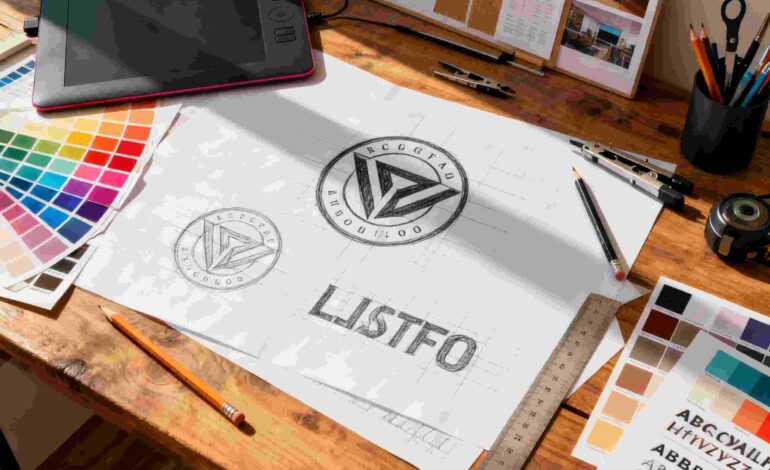
Begin with pencil and paper to freely explore ideas without digital constraints. Generate numerous concepts (aim for 20+ initial sketches) before evaluating and refining the most promising directions. This phase should emphasize quantity over quality to ensure a broad exploration of possibilities.
Step 4: Digital Development
Translate your strongest sketches into vector format using professional design software like Adobe Illustrator. This allows for:
- Precise shape refinement
- Systematic color exploration
- Easy scaling and adaptation
- Clean line work essential for reproduction
Step 5: Test Across Applications
A successful logo must function effectively across diverse contexts:
- Evaluate legibility at small sizes (favicon, social media profile)
- Test single-color versions for cost-effective printing
- Assess visibility on both light and dark backgrounds
- * Mock up realistic applications (business cards, websites, products, signage), including event-focused branding projects where a creative event management logo guide can help inform logo applications across promotional materials and event spaces.
Step 6: Refine and Finalize
Gather feedback from stakeholders and potential customers, then implement refinements. Pay particular attention to:
- Balanced proportions and visual weight
- Optical adjustments (compensating for how the eye perceives shapes)
- Typographic fine-tuning (kerning, spacing, alignment)
- Color refinement for consistency across media
Step 7: Create Usage Guidelines
Develop clear guidelines for logo implementation covering:
- Clear space requirements and minimum sizes
- Approved color variations (full color, one-color, reversed)
- Typography standards for accompanying text
- Incorrect usage examples to prevent brand dilution
Technical Considerations for Digital Age Logos
Scalability and Responsive Design
Modern logos must maintain clarity across an unprecedented range of sizes—from smartphone screens to building signage. Consider designing responsive logo variations: a detailed primary version, a simplified medium version, and an ultra-simplified favicon version.
Digital-First Color Systems
While traditional print-focused logos often used CMYK color palettes, contemporary logos should be optimized for digital displays using RGB and HEX values. Additionally, ensure sufficient color contrast for accessibility compliance (WCAG guidelines).
Animation and Interaction Potential
In digital environments, logos increasingly incorporate subtle animation or interactive elements. Consider how your logo might transition between states or respond to user interaction while maintaining brand recognition.
Avoiding Common Logo Design Pitfalls
- Overly Complex Designs – Details that look refined on a computer screen often become muddled when scaled down or reproduced on different materials.
- Trend Chasing – While contemporary aesthetics have value, logos built primarily on current trends often appear dated quickly. Aim for balance between freshness and timelessness.
- Literal Representations – Unless executed exceptionally well, overly literal logos (a book for a bookstore, a car for an auto dealer) fail to differentiate and may appear generic.
- Typography Troubles – Choosing overly decorative fonts or using multiple typefaces can compromise legibility and professionalism.
- Color Overreliance – Ensure your logo maintains impact in single-color applications for scenarios where full color isn’t available or practical.
Measuring Logo Effectiveness
A successful logo should:
- Be immediately recognizable to your target audience
- Communicate your brand essence without explanatory text
- Function effectively across all anticipated applications
- Distinguish your brand from competitors
- Maintain relevance as your business evolves
- Foster positive emotional associations with your brand
Consider conducting A/B testing with potential customers to gauge different logo concepts’ effectiveness before finalizing your design.
Future-Proofing Your Logo Investment
The most enduring logos balance contemporary appeal with timeless foundations. Consider these strategies:
Start Simple – Minimalist designs generally age better than complex ones and adapt more readily to evolving visual trends.
Build a System – Rather than a single static mark, consider developing a logo system with adaptable elements that can evolve while maintaining recognition.
Plan for Evolution – Even iconic logos like Pepsi, Google, and Microsoft have undergone careful evolution. Design with flexibility for future refinements rather than complete redesigns.
Integrating Your Logo into Comprehensive Brand Strategy
Your logo should serve as the anchor for a cohesive visual identity system. As discussed in our exploration of digital marketing logo design, this visual cornerstone must integrate seamlessly with your:
As discussed in our exploration of decoding the power of a digital marketing logo, this visual cornerstone must integrate seamlessly with your:
- Website design and user experience
- Marketing materials and advertising campaigns
- Social media presence and content strategy
- Product packaging and physical spaces
- Customer service interactions and touchpoints
Comparison of Logo Design Styles
| Logo Style | Core Concept | Key Characteristics | Best For / Industries | Notable Examples | Key Considerations |
| Wordmark (Logotype) | Stylized text of the company name. | Relies solely on typography, font choice, and unique letter modifications. | Companies with short, distinctive names; businesses wanting direct name recognition. | Google, Coca-Cola, FedEx. | Typography must be exceptionally strong and ownable. Legibility at all sizes is critical. |
| Pictorial Mark (Symbol) | Iconic, literal image representing the brand. | A recognizable symbol that can stand alone without text. Simple, scalable imagery. | Brands with a globally recognizable product or service; aiming for visual simplicity. | Apple (apple), Twitter (bird), Target (bullseye). | Symbol must have a clear, logical connection to the brand name or core offering. |
| Abstract Mark | Unique geometric form representing a brand idea. | Uses shapes and colors to convey emotion or a concept, not a literal object. Culturally neutral. | Large corporations, tech companies, or brands wanting to express abstract qualities like innovation or energy. | Pepsi (circle), Adidas (flower), Chase (octagon). | Requires significant marketing to build meaning behind the abstract shape. |
| Mascot Logo | Illustrated character that personifies the brand. | Often colorful, cartoonish, and friendly. Excellent for storytelling and engagement. | Brands targeting families, children, or food/sports industries; wanting an approachable, friendly image. | KFC (Colonel Sanders), Planter’s (Mr. Peanut), Michelin (Bibendum). | Can be difficult to translate into a sophisticated or luxury aesthetic. Highly detailed. |
| Combination Mark | Integrated symbol and text. | Versatile; elements can be used together or separately. Offers clear communication. | Almost any business, especially new companies needing both name recognition and a memorable symbol. | Burger King, Lacoste, Mastercard. | Offers the most flexibility. Ensure the elements work well together and apart. |
| Emblem Logo | Text enclosed within a symbol or badge. | Conveys tradition, authority, and heritage. Often has a classic, formal appearance. | Schools, government agencies, automotive brands, or businesses emphasizing craftsmanship and history. | Starbucks, Harley-Davidson, NFL. | Can be less versatile; detail may be lost when scaled down for digital use. |
Conclusion: Your Logo as a Strategic Asset
Exceptional logo design merges artistic creativity with strategic thinking, psychological insight, and technical precision. It requires understanding your brand’s essence, your audience’s perceptions, and your competitive landscape. The most effective logos aren’t merely attractive graphics—they’re visual shorthand for everything your company represents.
At Lead Loom Web, we approach logo design as both an art and a science, creating distinctive marks that establish immediate recognition while containing layers of strategic meaning. Whether you’re developing a new brand identity or revitalizing an existing one, investing in thoughtful, research-driven logo design delivers compounding returns throughout your brand’s lifespan.
Remember that your logo will often provide the first impression of your business—make it count by ensuring it authentically represents your values, resonates with your audience, and distinguishes you in the marketplace. With the right approach, your logo can become one of your most valuable business assets, building recognition and trust for years to come.
Saba Mirza is a Technology, Business & Digital Marketing Writer at Lead Loom Web with 3+ years of writing experience. Her work covers technology, digital marketing, SEO, business growth, artificial intelligence and emerging digital trends.
Author Profile →
Sameena Begum is a health, technology, and digital content reviewer who reviews selected articles to help ensure that information is presented clearly, accurately, and responsibly.
Reviewer Profile →