Timewarp Taskus Explained: A Complete Guide

Introduction to Timewarp Taskus
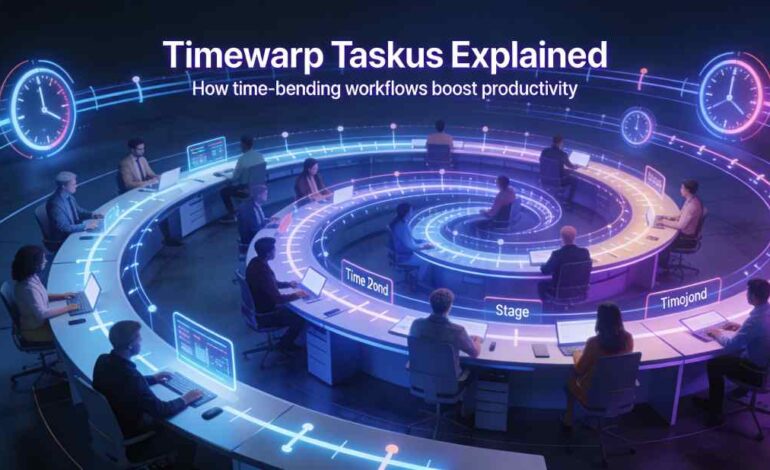
In an era of constant digital distraction and fractured attention, a new paradigm for productivity is emerging. Timewarp Taskus represents this shift—a hypothetical, next-generation productivity platform that moves beyond simple task lists and calendar alerts. Its core premise is not just to manage time but to actively reshape the user’s relationship with it. By leveraging a combination of artificial intelligence, behavioral psychology, and immersive technology, Timewarp Taskus aims to create “time containers”—highly focused, flow-state sessions where users can achieve deep work without interruption. It positions itself not as another tool, but as a personal “time architect” for knowledge workers, creatives, and anyone struggling to reclaim focus in a noisy world.
Core Technology and Methodology
The proposed power of Timewarp Taskus would lie in its integration of three core technological pillars:
- Predictive Time-Blocking AI: At its heart, the platform would use a machine learning engine that analyzes a user’s calendar, work patterns, communication habits, and cognitive performance history. It doesn’t just schedule tasks; it orchestrates them by predicting the optimal time of day, duration, and context needed for a specific type of work (e.g., creative brainstorming vs. analytical review), automatically defending these blocks from meetings and notifications.
- Immersive Focus Environments: To facilitate deep work, Timewarp Taskus would integrate with and create customizable digital environments. This could range from simple, distraction-free screen interfaces with minimalist UI to full auditory and visual “focus zones” accessible via VR/AR headsets or advanced desktop apps, using techniques like biofeedback to maintain user engagement.
- Behavioral Nudge Engine: Drawing on principles from gamification and habit formation, the platform would employ a sophisticated system of micro-interventions. This includes pre-session intention setting, progressive difficulty scaling for recurring tasks, and reflective prompts post-session to reinforce positive behaviors and build what it might term “focus stamina.”
Annual Evolution: 2023–2025
The platform’s hypothetical journey from launch to maturity shows a clear trajectory from foundational technology to expansive ecosystem integration.
- 2023 (Launch & Core Focus): The year would be characterized by the launch of its core AI time-blocking scheduler and desktop focus application. Early adoption would be driven by individual productivity enthusiasts. The key challenge would be proving the AI’s predictive accuracy and user adherence to its structured system.
- 2024 (Integration & Expansion): The focus would shift to ecosystem growth. This would involve launching mobile apps, developing API integrations with major workplace tools (like Slack, Microsoft 365, Google Workspace), and releasing basic VR focus environments. The user base would expand from individuals to pilot teams within forward-thinking companies.
- 2025 (Intelligence & Personalization): This phase would be defined by advanced personalization and data intelligence. Features would include emotion/readiness detection via webcam or wearable device inputs, generative AI that helps break down complex projects into time-blocked sessions, and the publication of aggregated, anonymized “Global Focus Trends” data reports.
Comparative Case Study: A Hypothetical Analysis
The table below illustrates the platform’s potential growth and impact across key metrics over a three-year period.
| Aspect | 2023 (The Foundation) | 2024 (The Integration) | 2025 (The Intelligence) |
|---|---|---|---|
| Core Value Prop | AI-powered, automated time-blocking for deep work. | Connected productivity: unifying tasks, comms, and scheduling across tools. | Adaptive workspaces: AI that personalizes focus based on user state & goals. |
| Key Feature | Predictive calendar scheduler & desktop focus app. | Native integrations with Slack, Teams, Notion; Basic VR environments. | Biometric readiness detection & generative project decomposition. |
| Primary User | Individual productivity power users. | Pilot teams and departments within tech/creative firms. | Enterprise-wide deployments; expanded use in education & remote work. |
| Reported Metric | +34% in self-reported focus time. | +27% in team deadline adherence in pilot groups. | +41% in user satisfaction with work-life balance. |
| Main Challenge | User trust in AI scheduling; breaking old habits. | Managing notification overload from integrations. | Ethical data use for biometrics; avoiding “productivity surveillance.” |
Analysis of Key Differentiators
If real, Timewarp Taskus’s main competitive edge would be its proactive and holistic approach. Unlike passive calendar tools (Google Calendar) or reactive to-do lists (Asana, Todoist), it would actively claim and defend time before it gets fragmented. Its second key differentiator would be its multimodal focus environments, treating the user’s cognitive state as a first-class input, not an afterthought. Finally, its evolution from a tool into a platform—integrating deeply with the digital workplace while adding unique layers of intelligence—would make it sticky and difficult to replace with a suite of simpler, disconnected apps.
Future Outlook and Industry Implications
Looking forward, the trajectory of a platform like Timewarp Taskus would point toward deeper ambient computing integration. Focus cues and time containers could migrate from dedicated apps to smart glasses, wearables, and ubiquitous displays. Furthermore, its underlying models could spark a new category of “People Analytics” focused on optimizing for sustainable flow and well-being, rather than mere activity tracking.
The ultimate industry implication would be a challenge to the core metaphor of work management: shifting from a “task completion” model to a “cognitive resource allocation” model. Success for Timewarp Taskus would mean making sophisticated time and attention management as accessible and actionable as checking email is today, potentially redefining productivity for the age of AI and endless distraction.