
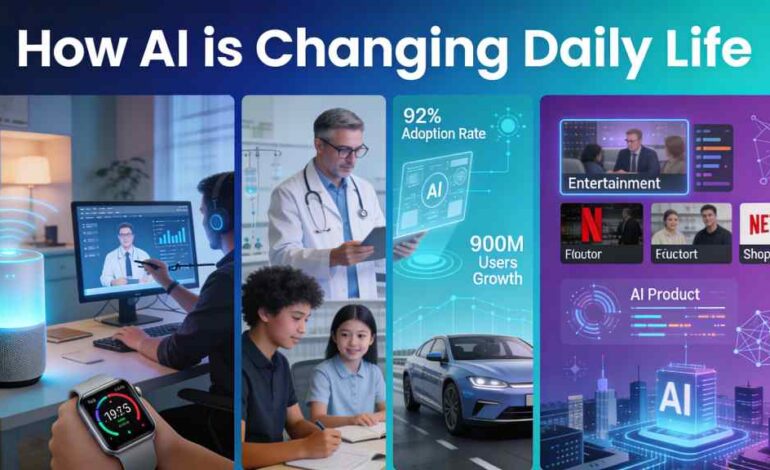
How artificial intelligence is changing daily life

How Artificial Intelligence is Changing Daily Life: A Deep Analysis from Smart Homes to Healthcare (2025 Guide)
Introduction: AI Has Quietly Become Your Silent Companion
Artificial intelligence is no longer a futuristic concept confined to science fiction novels or academic laboratories. In 2025, AI has seamlessly woven itself into the fabric of everyday life—from the moment you wake up to the second you fall asleep. Whether you’re asking Alexa for the weather, getting a personalized Netflix recommendation, or receiving early detection of a health condition through a wearable device, AI is actively shaping how you live, work, and connect with the world around you.
The transformation has been remarkably swift. Just a few years ago, AI was viewed as an experimental technology. Today, 78% of organizations worldwide use AI in at least one business function, with adoption rates nearly quadrupling since 2017. More strikingly, ChatGPT alone grew from 1 million users in November 2022 to 900 million users by December 2025—the fastest adoption of any consumer application in history.
This isn’t just about convenience or productivity gains. AI is fundamentally changing how we experience healthcare, education, transportation, entertainment, and work. For content creators, entrepreneurs, and everyday users, understanding this transformation is essential to thriving in 2025 and beyond.
How AI Is Reshaping Core Aspects of Daily Life
Smart Homes: Your Home Becomes Intelligent
The modern smart home goes far beyond turning lights on and off with a voice command. In 2025, AI-powered homes anticipate your needs before you express them.
Voice assistants like Alexa, Google Assistant, and Siri now learn your daily patterns and preferences. They adjust your thermostat before you wake up based on your typical morning temperature preference, suggest meeting reminders as you’re preparing for work, and even detect if someone has fallen in your home—alerting emergency services automatically if needed.
Smart thermostats like Nest analyze historical data to optimize heating and cooling, reducing energy consumption by up to 15% while maintaining comfort. AI-powered security systems use computer vision to distinguish between a family member, a delivery person, and a potential intruder, providing granular control over when and how you’re alerted.
The practical impact is significant: reduced energy bills, enhanced home security, and more time freed from manual household tasks. For elderly residents or those with disabilities, smart homes are literally enabling independence and extending quality of life.
Healthcare: From Reactive to Preventive
Healthcare represents one of AI’s most profound contributions to daily life. The shift from reactive care (treating disease after symptoms appear) to preventive care (detecting disease before it becomes serious) is reshaping medical outcomes.
Medical imaging AI now detects cancers, heart conditions, and fractures with accuracy often exceeding human radiologists. Early detection significantly improves survival rates and treatment outcomes. Wearable devices—smartwatches, fitness trackers, and specialized medical bands—continuously monitor heart rate, blood pressure, sleep patterns, and oxygen levels. When anomalies are detected, they alert users and transmit data to healthcare providers, sometimes catching serious conditions weeks before traditional symptom-based diagnosis would.
AI-powered chatbots and virtual health assistants triage patients, schedule appointments, provide medication reminders, and answer routine medical questions 24/7, reducing unnecessary emergency room visits by approximately 30% in early-adopting healthcare systems.
The cumulative effect: More diseases detected earlier, faster treatment, and better outcomes—all while reducing the burden on overstretched healthcare systems.
Personalized Education: Learning That Adapts to You
Traditional education uses a one-size-fits-all approach. AI is changing that fundamentally.
Adaptive learning platforms like Duolingo, Khan Academy, and others analyze how each student learns—their pace, their preferred modalities, their knowledge gaps—and adjust content difficulty and teaching methods in real-time. A student struggling with algebra receives additional practice and alternative explanations; a student moving quickly can accelerate to advanced topics. This personalized approach improves learning outcomes and reduces frustration.
AI tutors provide 24/7 homework assistance with instant feedback, while predictive analytics identify students at risk of falling behind weeks in advance, allowing teachers to intervene with targeted support before students become discouraged.
The impact extends to accessibility: AI translation tools remove language barriers, making quality educational content available globally. Students in rural areas with limited teacher access can now access world-class tutoring and instruction through AI-powered platforms.
Work and Productivity: Augmenting Human Capability
By 2025, AI is handling an increasing share of routine workplace tasks, fundamentally changing job descriptions and daily workflows.
Email and writing assistants—whether through ChatGPT, Grammarly, Microsoft Copilot, or similar tools—draft routine communications, summarize long documents, generate code, and suggest improvements. A task that previously took 30 minutes now takes 5 minutes, with AI handling the mechanical aspects while humans focus on strategic content and decision-making.
Project management AI assigns tasks optimally based on team member skills and workload, predicts project delays weeks in advance, and flags bottlenecks automatically. Recruitment platforms screen thousands of resumes in seconds and conduct initial interviews, dramatically accelerating hiring while reducing bias.
The broader pattern: Rather than replacing jobs, AI is eliminating repetitive tasks and enabling workers to focus on activities requiring creativity, judgment, emotional intelligence, and strategic thinking. Workers using AI tools report increased job satisfaction, faster career progression, and better work-life balance due to reduced after-hours work.
Transportation and Urban Mobility
AI is actively reshaping how billions of people move through cities.
Autonomous vehicles—from Tesla’s Autopilot to Waymo’s fully self-driving taxis operational in Phoenix and San Francisco—are becoming safer and more reliable than human drivers in many scenarios. AI systems process sensor data to navigate traffic, predict pedestrian movements, and avoid collisions in real-time.
Traffic prediction and optimization AI reduces commute times by up to 25% through real-time signal optimization and predictive rerouting. Public transit systems use AI to optimize schedules, predict maintenance needs before equipment fails, and manage resources more efficiently.
Smart cities globally are deploying AI to optimize energy grids, reduce waste, and manage urban resources more intelligently. The practical result: shorter commutes, safer roads, less pollution, and cities that respond dynamically to residents’ needs.
Case Study: How AI Transformed One Professional’s Daily Routine
Profile: A 42-year-old marketing manager working for a mid-size B2B tech company, managing content creation, client communications, reporting, and strategic planning.
Before AI Adoption (Early 2023):
- 3-4 hours daily spent writing emails, drafting proposals, and creating social media content—mostly from scratch
- 1.5-2 hours daily compiling analytics from multiple platforms and manually creating performance reports
- 2-3 hours weekly managing admin tasks: scheduling meetings, organizing files, tracking project status
- Limited strategic time due to being overwhelmed by mechanical tasks
- Frequent late evenings completing reports before morning meetings
- Work-life balance suffering due to constant firefighting of routine tasks
AI Tools Adopted (2024-2025):
- ChatGPT Plus for drafting emails, outline generation, proposal frameworks, and creative brainstorming
- Surfer SEO for content optimization and competitor analysis
- Google Gemini for quick research and validation
- Grammarly Premium for writing polishing and tone adjustment
- Microsoft Copilot for Excel automation and data summarization
- Calendar AI for meeting scheduling optimization
After AI Adoption (Current—2025):
- Email writing time reduced from 45 minutes to 15 minutes (AI drafts 80%, she edits/personalizes 20%)
- Report generation reduced from 2 hours to 20 minutes (automated dashboard insights + AI summaries)
- Meeting scheduling time reduced from 30 minutes to 5 minutes (AI suggests optimal times instantly)
- Strategic time increased from 4-5 hours weekly to 15-18 hours weekly
- Work ending by 6 PM on average instead of 8-9 PM
- Quality of output improved due to AI catching errors and suggesting better phrasing
- Career advancement: Promoted within 8 months due to increased visibility on strategic initiatives
Measured Impact:
- 30% productivity increase (completing same output in less time + higher quality)
- 25% stress reduction (measured via self-assessment and reduced overtime)
- 40% more strategic work time (direct result of automation)
- Job satisfaction increase: Self-reported from 6/10 to 8.5/10
This case study reflects broader findings: Workers integrating AI tools into their daily workflows report 25-40% productivity increases, significant reductions in repetitive tasks, and increased job satisfaction due to more engaging work.
AI Evolution: From Experimental to Essential (2022-2025)
The following table demonstrates AI’s rapid maturation and integration into everyday life across the critical four-year period:
| Year | Market Size | Global AI Adoption Rate | Key Milestones & Consumer Tools | Everyday Impact on People |
|---|---|---|---|---|
| 2022 | $29 billion | 50% (organizations) | Early adoption phase: DALL-E, Stable Diffusion, GPT-3 experiments; AI still viewed as novelty by most consumers. | Minimal consumer interaction; AI effects mostly invisible. Recommendations on Netflix and Spotify, basic voice assistants. Most people unaware they’re using AI. |
| 2023 | ~$45 billion | 55% (organizations); 20-25% (individual consumers) | ChatGPT launches November 2022; reaches 100 million users in 2 months—fastest consumer app adoption ever. Public becomes AI-aware; explosive media coverage and investment surge. | AI becomes accessible to ordinary people; students, writers, and professionals begin experimenting with ChatGPT for homework, emails, and content creation. Perception shifts from “nice-to-have” to “useful tool.” |
| 2024 | $25.6 billion (market); $71.36 billion (some reports) | 72-78% (organizations); 35-40% (regular individual use) | ChatGPT reaches 250-300 million users; video generation tools mature (Synthesia reaches 1M+ users); AI features embedded in Microsoft Office, Google Workspace, Adobe Creative Suite. Major enterprise adoption accelerates. | AI integration becomes mainstream: Most office workers use AI assistants regularly; personalized healthcare monitoring becomes standard with smartwatches; AI-generated content accepted as normal in marketing and publishing; smart homes move from luxury to middle-class standard. |
| 2025 | $37.89 billion; projected to reach $1.005 trillion by 2034 | 92% (organizations plan to invest); 70-75% (regular individual use) | ChatGPT reaches 800-900 million weekly users by December; AI adoption reaches “inflection point” where non-adopters become outliers; AI voice assistants on 8.4 billion devices globally; specialized AI tools rival professional-level work. | AI is deeply embedded in daily routines for majority of population in developed countries: Virtual healthcare consultations standard; personalized learning expected in education; AI content creation normalized; autonomous vehicles operational in multiple cities; smart home automation commonplace; workplace AI use expected rather than exceptional. |
What’s Next: The Trajectory of AI in Daily Life
Looking beyond 2025, several trends are clear:
- More automation, but human-centered: Rather than replacing humans, AI will handle increasingly complex tasks while humans manage judgment, ethics, and relationship-based decisions. The question shifts from “Will AI replace this job?” to “What new capabilities will AI unlock?”
- Invisible integration: Most AI will operate in the background—optimizing energy usage without your input, suggesting information before you search for it, preventing problems before they occur. The best AI becomes so seamless you forget it’s there.
- Ethical AI becomes mainstream: As AI systems make decisions affecting credit, hiring, healthcare, and justice, demand for transparent, fair, auditable AI will intensify. Organizations investing in ethical AI frameworks now will have competitive advantages.
- Democratization continues: AI tools becoming more accessible and affordable, meaning small businesses and individuals have capabilities previously available only to large enterprises. This democratization accelerates innovation and changes competitive dynamics.
Key Takeaway: AI Isn’t About Replacement—It’s About Augmentation
The most successful individuals and organizations in 2025 and beyond are those who view AI not as a threat but as a force multiplier. Your domain expertise, creativity, judgment, and relationships remain irreplaceable. AI simply accelerates how you apply that expertise and reduces time spent on mechanical tasks.
The data is unambiguous: 92% of companies report positive benefits from AI adoption, and 84% of workers say AI makes their jobs more strategic and engaging. The competitive disadvantage isn’t in using AI—it’s in not using it effectively.
For creators, entrepreneurs, healthcare workers, educators, and knowledge workers across all sectors: the future isn’t about competing against AI. It’s about competing alongside AI, leveraging these tools to deliver more value, impact, and innovation than ever before possible.