

The Ultimate Guide to Free Marketing Tools for Startups

 Saba Mirza
Technology, Business &
Digital Marketing Writer
Saba Mirza is a Technology, Business
& Digital Marketing Writer at Lead
Loom Web with 3+ years of writing
experience covering technology,
digital marketing, business, SEO,
artificial intelligence and emerging
digital trends.
View Author Profile →
Technology, Business & Digital Marketing Writer
Saba Mirza
Technology, Business &
Digital Marketing Writer
Saba Mirza is a Technology, Business
& Digital Marketing Writer at Lead
Loom Web with 3+ years of writing
experience covering technology,
digital marketing, business, SEO,
artificial intelligence and emerging
digital trends.
View Author Profile →
Technology, Business & Digital Marketing Writer
 Sameena Begum
Health, Technology &
Digital Content Reviewer
Sameena Begum is a health, technology,
and digital content reviewer who
reviews selected articles to help
ensure that information is presented
clearly, accurately, and responsibly.
View Reviewer Profile →
Health, Technology & Digital Content Reviewer
Sameena Begum
Health, Technology &
Digital Content Reviewer
Sameena Begum is a health, technology,
and digital content reviewer who
reviews selected articles to help
ensure that information is presented
clearly, accurately, and responsibly.
View Reviewer Profile →
Health, Technology & Digital Content Reviewer
Introduction: Why Startups Struggle with Marketing
Every startup faces the same structural contradiction: growth requires visibility, but visibility often requires capital. Early-stage companies must acquire users, validate positioning, and build brand authority—usually with constrained budgets.
The Startup Genome 2023 Global Startup Report found that 42% of startup failures are linked to poor product-market fit and weak market positioning rather than product defects. This indicates a critical insight: marketing failure—not engineering failure—is frequently the root cause of collapse.
The solution is not reckless spending. It is strategic leverage of the modern freemium marketing ecosystem.
Today’s free marketing tools provide 60–80% of enterprise-level functionality when deployed systematically. For early-stage startups, that is more than sufficient to build traction.
A Strategic Framework for Free Marketing Tools
To avoid fragmentation, startups should structure their marketing stack across five core domains:
- Analytics & Market Intelligence
- Content Creation
- Distribution & Community
- SEO & Organic Growth
- Execution & Collaboration
Each layer compounds the effectiveness of the others.
1. Analytics & Market Intelligence
Marketing without measurement is speculation.
Google Analytics 4 (GA4)
Google Analytics 4 remains the foundational analytics platform for startups. The free tier allows up to 10 million monthly events, which covers most early-stage companies.
It provides:
- User acquisition tracking
- Funnel visualization
- Event-based behavior analysis
- Retention measurement
The learning curve is non-trivial, but mastery transforms intuition into data-driven strategy.
SimilarWeb
SimilarWeb offers limited but useful competitive benchmarking in its free version. You can analyze:
- Traffic estimates
- Referral channels
- Audience interests
This intelligence is particularly valuable when validating market positioning.
Ubersuggest
Created by Neil Patel, Ubersuggest provides:
- Keyword research
- SEO audits
- Competitor analysis
The free tier limits daily searches but is sufficient for focused, strategic research.
2. Content Creation & Brand Assets
Content is the engine of modern inbound marketing.
Canva
Canva democratized visual design. The free version includes:
- Thousands of templates
- Stock imagery
- Basic brand kits
- 5GB cloud storage
Startups can produce social media creatives, pitch decks, infographics, and blog visuals without hiring designers.
Grammarly
Grammarly ensures professional-grade written communication. The free tier covers:
- Grammar correction
- Tone clarity
- Basic rewriting suggestions
Clean writing directly impacts credibility and conversion rates.
Unsplash & Pexels
Unsplash and Pexels provide royalty-free imagery, eliminating licensing costs for marketing visuals.
3. Distribution & Community Building
Content without distribution is invisible.
Buffer
Buffer enables:
- Scheduling across 3 channels
- 10 queued posts per channel
- Basic analytics
It creates workflow efficiency between content production and publishing.
Mailchimp
Mailchimp offers a free tier supporting up to 2,000 contacts and 10,000 monthly emails.
Email remains one of the highest ROI channels. Even at early scale, automated onboarding sequences increase retention.
Slack & Discord
Slack and Discord are powerful for building engaged communities around SaaS, gaming, and Web3 startups.
Community compounds growth through:
- Peer-driven support
- Social proof
- Organic advocacy
4. SEO & Organic Visibility
Organic search is the most sustainable acquisition channel.
Google Search Console
Google Search Console provides:
- Query data
- Indexing diagnostics
- Technical alerts
- Click-through rate analysis
Combined with GA4, it gives full-funnel visibility from search query to on-site conversion.
AnswerThePublic
AnswerThePublic visualizes search intent by mapping real user questions around keywords. This improves content relevance and long-tail targeting.
Screaming Frog SEO Spider
Screaming Frog SEO Spider allows crawling up to 500 URLs for free, identifying:
- Broken links
- Missing meta tags
- Redirect chains
- Duplicate content
Technical hygiene prevents ranking losses.
5. Productivity & Execution
Strategy fails without execution discipline.
Trello
Trello uses Kanban boards for:
- Editorial calendars
- Campaign workflows
- Task prioritization
Notion
Notion combines:
Documentation
Databases
CRM-style tracking
Content planning
It reduces tool sprawl in early-stage teams.
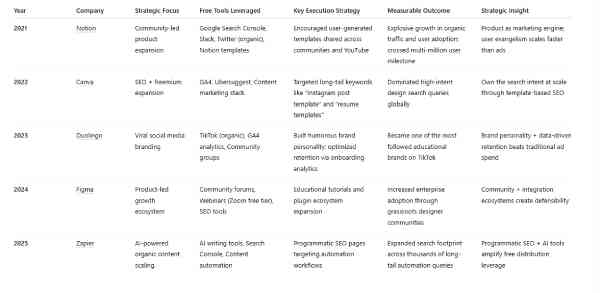
Startup Marketing Case Study (2021–2025)
Deep Strategic Insight: Integration Is the Multiplier
The real advantage does not lie in isolated tools—but in integration.
Examples:
- GA4 + Search Console → Search intent + behavior mapping
- Canva + Buffer → Seamless content-to-distribution workflow
- Mailchimp + website forms → Automated onboarding funnels
Tool synergy creates leverage.
Tool synergy creates leverage. This becomes even more effective when startups combine technology with empathetic marketing, using customer insights and feedback to make their campaigns more relevant and human.
Tactical Roadmap by Growth Stage
Pre-Launch (0–100 Users)
-
- Market research via AnswerThePublic
- Basic visuals via Canva
- Landing page tracking via GA4
Invest in a small business web design project to create a strong foundation for SEO, conversions, and customer trust
Early Traction (100–1,000 Users)
- Implement Mailchimp onboarding
- Schedule posts via Buffer
- Monitor search via Search Console
- Consider affiliate marketing for beginners as a low-cost way to expand reach through performance-based partnerships
Growth Stage (1,000–10,000 Users)
- Technical SEO via Screaming Frog
- Structured content system in Notion
- Community building in Slack/Discord
* Technical SEO via Screaming Frog
* Structured content system in Notion
* Community building in Slack/Discord
* Explore ELF programmatic advertising as a scalable approach to targeted digital campaigns
Conclusion: Frugality as Competitive Advantage
Free marketing tools are not temporary substitutes—they are force multipliers when used strategically.
Constraints sharpen focus:
- Clearer measurement
- Smarter prioritization
- Deeper customer alignment
As demonstrated by Duolingo and Notion, global scale does not require proportional marketing spend. It requires strategic integration, disciplined execution, and relentless value creation.
Saba Mirza is a Technology, Business & Digital Marketing Writer at Lead Loom Web with 3+ years of writing experience. Her work covers technology, digital marketing, SEO, business growth, artificial intelligence and emerging digital trends.
Author Profile →
Sameena Begum is a health, technology, and digital content reviewer who reviews selected articles to help ensure that information is presented clearly, accurately, and responsibly.
Reviewer Profile →